The Civil War Battlefield of Cardiff
A.P.A.C. Ltd was commissioned to undertake an archaeological metal detector survey at Plasdŵr, west of Cardiff, in advance of works associated with a new water-main diversion. The survey crossed agricultural land on the eastern periphery of the known Battle of St Fagans landscape and was undertaken specifically to identify and record material potentially associated with the fighting of 8 May 1648. The results produced important new evidence for Civil War activity within this wider battlefield landscape.
The Battle of St Fagans
The Battle of St Fagans, fought on 8 May 1648, was one of the most significant engagements of the Second English Civil War in Wales. Royalist forces, including troops led by Major-General Rowland Laugharne and Colonels Powell and Poyer, were attempting to seize Cardiff in the name of King Charles I. They were intercepted near St Fagans by a smaller Parliamentary army of around 3,000 men under Colonel Thomas Horton.
The fighting lasted for around two hours and involved significant cavalry action. The Royalist force was decisively defeated, with approximately 3,000 soldiers and more than 400 officers captured, along with substantial quantities of weapons and equipment. The defeat effectively ended Royalist hopes of regaining control of Wales and allowed Parliamentary forces to strengthen their position across the region.
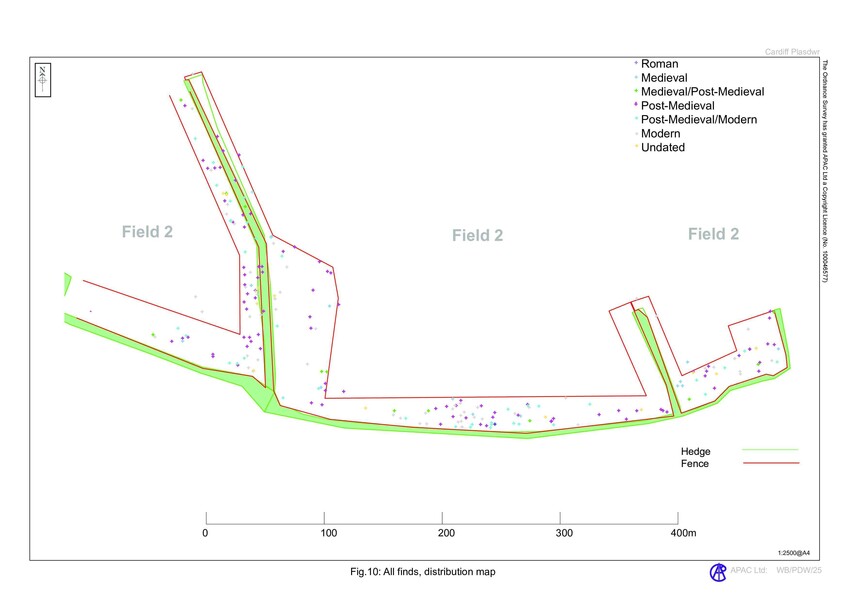
To the left is the spatial distribution of all finds recovered during the archaeological metal detector survey at Plasdŵr. Each find was individually recorded and plotted within the survey area, allowing the overall pattern and concentration of artefacts across the site to be examined. The finds are colour-coded according to their assessed date, with the key distinguishing Roman, Medieval, Medieval/Post-Medieval, Post-Medieval, Post-Medieval/Modern, Modern and undated material. The plan demonstrates both the spread of finds along the survey corridor and areas where greater concentrations of artefacts were recorded.
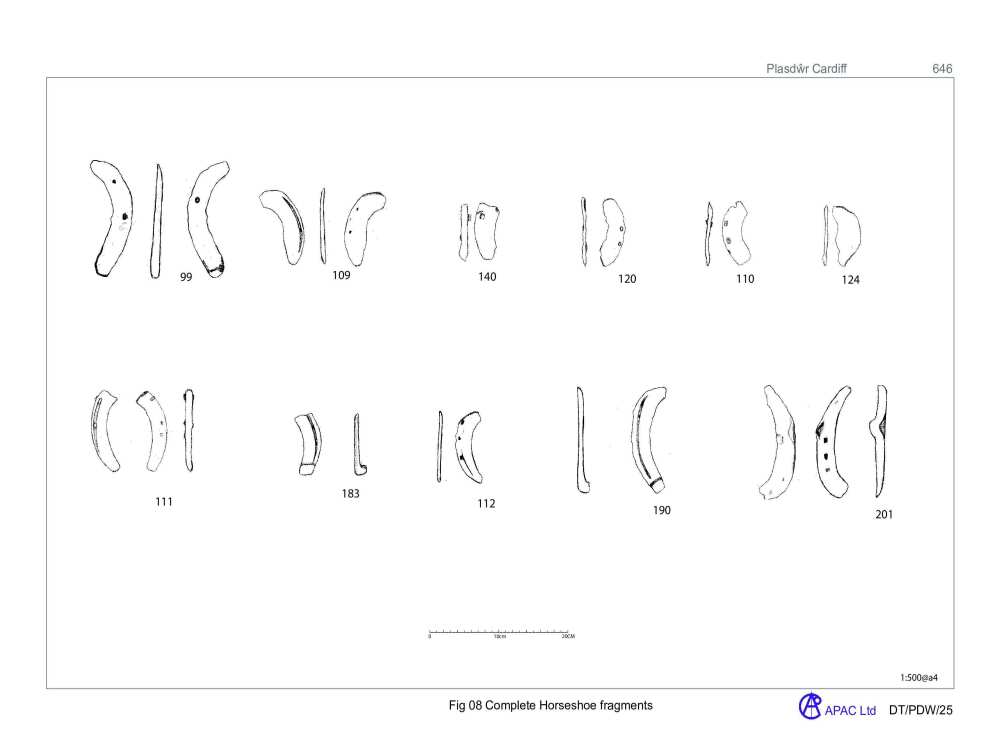
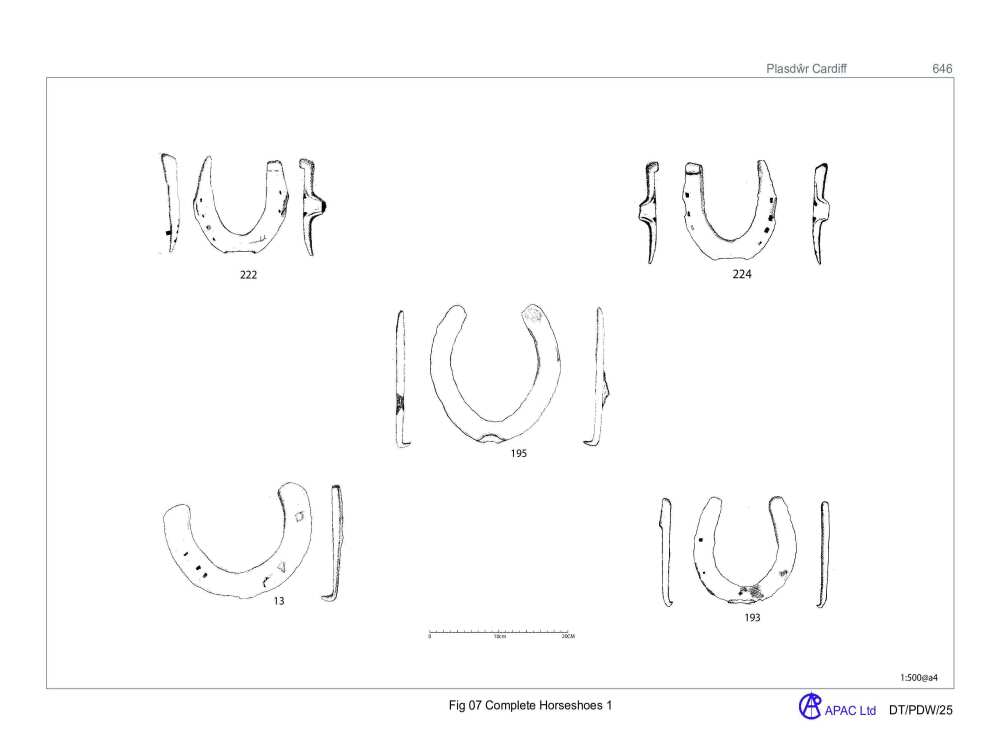
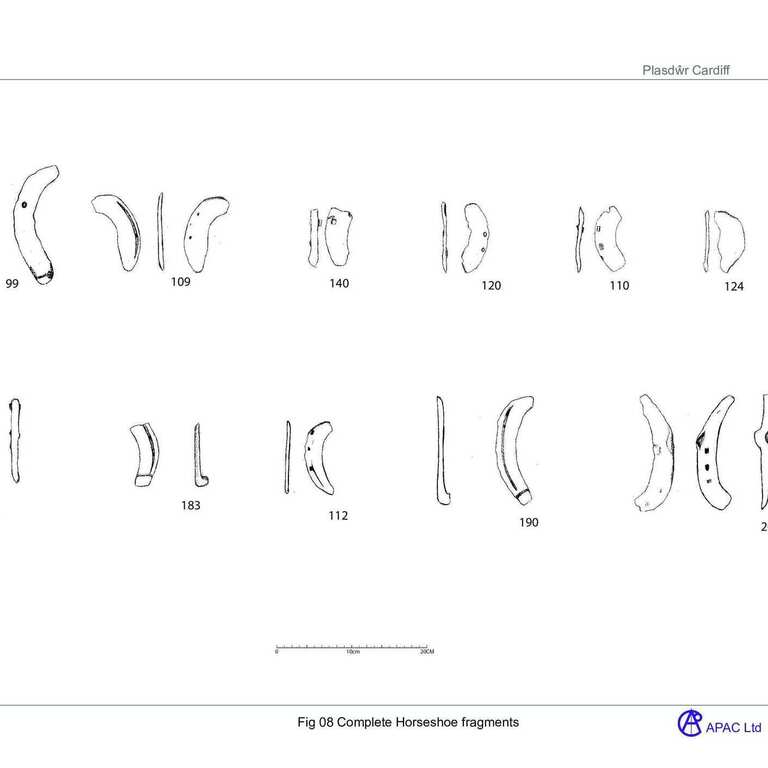
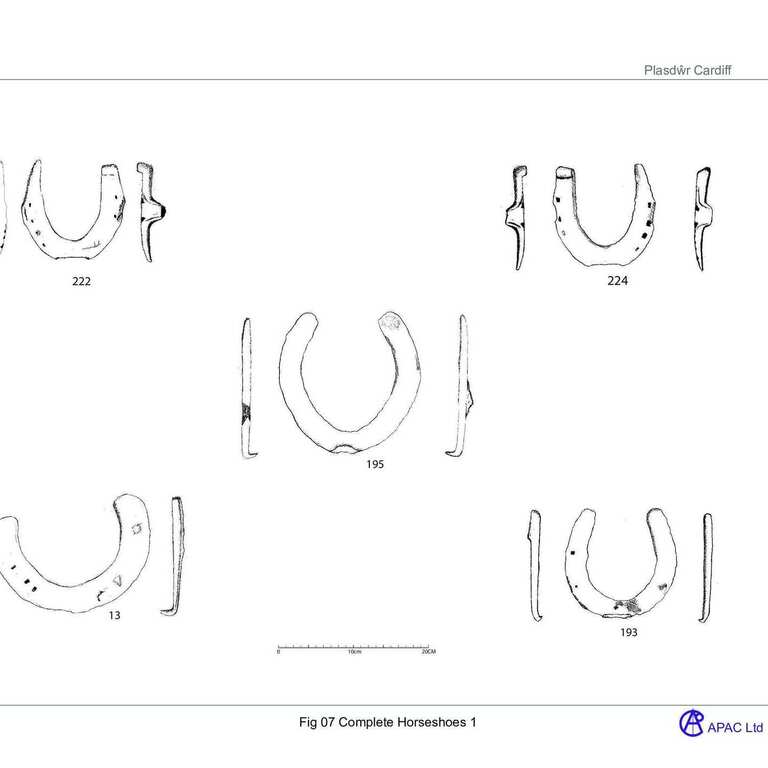
These archaeological drawings were produced in-house by a member of A.P.A.C. Ltd to record the horseshoes and horseshoe fragments recovered during the Plasdŵr metal detector survey. The assemblage consisted of 16 iron horseshoes, including five complete examples and eleven fragments. Each example was illustrated from several angles so that diagnostic features, which were often difficult to distinguish clearly in photographs because of corrosion, could be accurately recorded.
The illustrations enabled features including toe shape, branches, nail holes, fullering, calks and overall symmetry to be compared, helping to establish the likely date of each horseshoe. The assemblage represents activity spanning from the medieval period through to the early Industrial period, with several examples dating to, or close to, the period of the Battle of St Fagans in 1648.